


I’m excited to share something. A beautiful thing has come full circle.
If I had more self-control, I might wait until Gītā Jayantī in December. But there is also the old wisdom: when something is auspicious, it should be done immediately.
Lately, my seventeen-year-old son has been asking philosophical and existential questions. We haven’t tried to force religious conclusions upon him. Our home has standards—basic etiquette, respect, vegetarianism—but we don’t try to make our children perform a faith that has not yet become their own. Rather, we’ve kept confidence that Kṛṣṇa brought our children to us to love and serve, trusting that, in time, jijñāsu—inquisitiveness—may naturally arise. We also prepared for the possibility that we may never get to see this, but our job is to love and serve them anyway. Turns out, that approach seems to have worked, at least for our seventeen-year-old. To explain how I’ve responded to this joyful occurrence, I need to back up a little and convey some things from my life and from my current perspective on how transcendental knowledge is transmitted.
I feel fortunate that shortly after I started chanting and taking Kṛṣṇa consciousness seriously, someone gave me some cassettes of a narration of Bhagavad-gītā by a dearly missed devotee named Pūrṇacandra Svāmī. It’s called Gītāmṛta.
His narration had a strong effect on my mind and raised so many questions. I would listen to it over and over while I rode the train into the city, while I took respite from street book distribution, while I cooked, while I cleaned, and even while I showered. It became my constant companion, and rather than growing stale, it seemed to deepen with every listening. I still often listen to it in the car when I commute to and from work. It consistently delivers what it says on the tin: the nectar of Bhagavad-gītā. So I’m elated to be able to give this to my son.
Before he left this world, my wife and I had the good fortune to speak with Pūrṇacandra Svāmī in Māyāpur. I expressed my gratitude for his presentation, and he responded graciously and humbly. He was just satisfied to have helped me to appreciate such a wonderful literature as Bhagavad-gītā. He explained that it was based on Gauḍīya commentary from his spiritual father, His Divine Grace A.C. Bhaktivedanta Svami Prabhupāda, as well as Śrīla Viśvanātha Cakravartī Ṭhākura and Śrīla Baladeva Vidyābhūṣaṇa. He originally developed the recordings to assist students in his Gītā study course in England. He seemed to see it simply as service, something to be shared widely and freely.
Gauḍīya Vaiṣṇavism is a tradition of commentary. We even have commentaries on commentaries. This is how we present or, in our case, re-present/represent the teachings of our ācāryas. Every time we may be called upon to speak, we should feel this as our purpose, and, like a tree heavy with fruit, we should bow down and serve others the fruits of our predecessors’ messages. This is the path toward qualification.
If someone were to transcribe such a presentation on, say, a particular verse of Bhagavad-gītā, then they’d be participating in the commentarial tradition, the value of which would be determined by the speaker’s authenticity, realization, and ability to transparently convey the meaning in its intended context. When we speak in this mood of representation, our individuality is not erased. It is purified and revealed—often without our even noticing. Blessings can impart an otherworldly ambrosia to even the most supposedly “unqualified” jīva. Really, that’s my aspiration now with Suburban Mysticism. May these words be blessed. May my motivation be true. May our minds become peaceful. May our hearts become open. May we come to desire the ever-increasing bliss of Kṛṣṇa’s affection. Kṛṣṇa is so kind to us.
मूकं करोति वाचालं पङ्गुं लङ्घयते गिरिम्
यत्-कृपा तम् अहं वन्दे परमानन्द-माधवम्mūkaṁ karoti vācālaṁ paṅguṁ laṅghayate girim
yat-kṛpā tam ahaṁ vande paramānanda-mādhavamMādhava is transcendentally blissful. I offer my respectful obeisances unto Him, whose compassionate grace can make the mute eloquent and enable the lame to cross mountains.
(From Śrīdhara Svāmī’s Bhāvārtha-dīpikā commentary on the first verse of Śrīmad-Bhāgavatam; also quoted by Kṛṣṇadāsa Kavirāja Gosvāmī in Śrī Caitanya-caritāmṛta, Madhya-līlā 17.80)
Commentary is not peripheral to bhakti; it is one of the ways bhakti culture lives, travels, and deepens. It’s a huge part of bhakti praxis. In one of the Gītā’s seed verses (10.9), Kṛṣṇa says, “kathayantaś ca māṁ nityaṁ tuṣyanti ca ramanti ca / They derive great satisfaction and bliss from always enlightening one another and conversing about Me.” I personally take delight in hearing anyone’s sincere attempt to speak or write on the Bhagavad-gītā. Just as Kṛṣṇa has a personal and inimitable relationship with each of us, his words in the Gītā have a unique connection to us too. Two different coloured rays of light can converge and produce a new and unique colour; similarly, there are an infinite number of permutations possible from the combination of Kṛṣṇa’s light and that light reflected by the living entities. This prismatic reality is not limited by external designation—gender, race, social position, or how long one has been practicing bhakti in this lifetime. We give unique pleasure to our beloved and are deeply valued by Him for that.
About five-hundred years ago in the holy place of Śrī Raṅga-kṣetra, a brāhmaṇa Vaiṣṇava used to visit the temple daily and recite the entire text of Bhagavad-gītā but struggled to pronounce the words correctly. Sometimes people criticized and laughed at him, but he was so ecstatic reading that he wasn’t discouraged. Sometimes during his reading, the brāhmaṇa’s hairs would stand on end. Tears welled up in his eyes, and his body trembled and perspired.
Seeing this, Śrī Caitanya Mahāprabhu smiled and asked the brāhmaṇa, “My dear sir, why are you in such ecstatic love? Which section of the Bhagavad-gītā gives you such transcendental pleasure?”
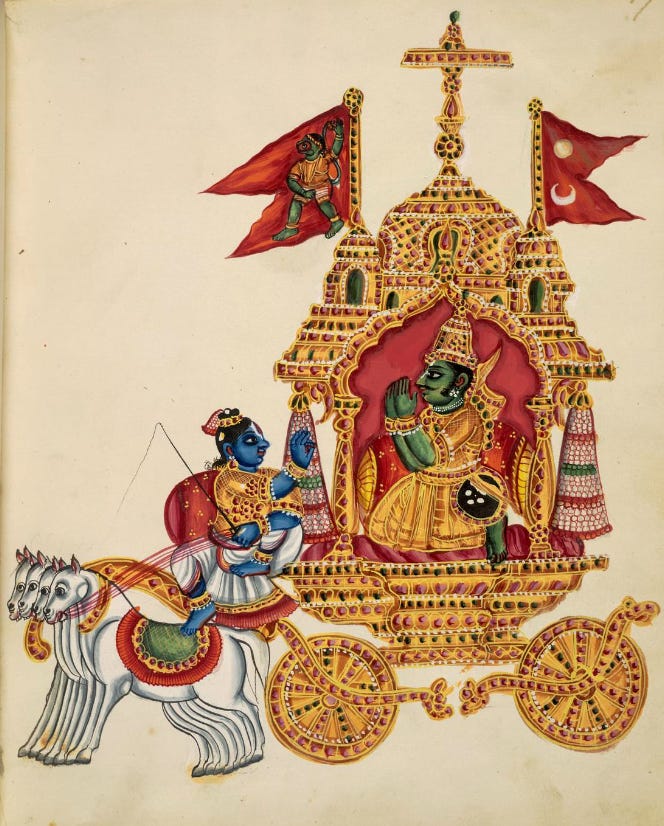
The brāhmaṇa replied, “I am illiterate and therefore do not know the meaning of the words. Sometimes I read the Bhagavad-gītā correctly and sometimes incorrectly, but in any case I am doing this as advised by my spiritual teacher. Actually I only see Lord Kṛṣṇa sitting on a chariot as Arjuna’s charioteer. Taking the reins in His hands, He appears very beautiful and blackish. While seeing Him instruct Arjuna, I’m filled with bliss. As long as I read the Bhagavad-gītā, I simply see the Lord’s beautiful features. That’s why I keep reading, and my mind cannot be distracted from this.”
Śrī Caitanya told the brāhmaṇa, “Indeed, you are an authority in the reading of the Bhagavad-gītā. Whatever you know constitutes its real purport.”
After saying this, Lord Caitanya Mahāprabhu embraced the brāhmaṇa, and the brāhmaṇa, catching the lotus feet of the Lord, began to cry.
So we should speak, write, and narrate Kṛṣṇa’s glories to our hearts’ content. The anxiety that says “I am not qualified” should not be ignored but educated. We should learn what “qualification” actually means.
Kṛṣṇa says to Arjuna near the conclusion of Bhagavad-gītā (18.70):
अध्येष्यते च य इमं धर्म्यं संवादमावयोः ।
ज्ञानयज्ञेन तेनाहमिष्टः स्यामिति मे मतिः ॥७०॥adhyeṣyate ca ya imaṁ dharmyaṁ saṁvādam āvayoḥ
jñāna-yajñena tenāham iṣṭaḥ syām iti me matiḥAnd I declare that he who studies this sacred conversation of ours worships Me by his intelligence.
Hearing my son begin to ask the same questions that once captivated me has taught me how spiritual culture survives. Someone receives something precious, lives with it, is changed by it, and then, when the time is right, places it before someone else. Not as an owner. Not as a manipulator. Not as a controller. As a servant. That is what Gītāmṛta was for me, and that’s what I hope it may become for him in whatever way Kṛṣṇa desires. I pray for my readers’ blessings in this regard.
If you've read this far, I have two gifts to share:
His Divine Grace A.C. Bhaktivedanta Svami Prabhupāda chanting chapters 1-11 of the Bhagavad-gītā (link)
And one of the greatest treasures of my life:
Gītāmṛta by Pūrṇacandra Svāmī (link)

Suburban Mysticism is free, but if you feel inspired and want to return some love, consider helping Ekendra to care for cows, or share the article with others.
As someone who was born and raised within this culture of Krishna consciousness, and is now a mother to an almost-3-year-old son, I just love this whole section: "Our home has standards—basic etiquette, respect, vegetarianism—but we don’t try to make our children perform a faith that has not yet become their own. Rather, we’ve kept confidence that Kṛṣṇa brought our children to us to love and serve, trusting that, in time, jijñāsu—inquisitiveness—may naturally arise. We also prepared for the possibility that we may never get to see this, but our job is to love and serve them anyway. Turns out, that approach seems to have worked, at least for our seventeen-year-old." It's a beautiful reminder for me that when I was left well enough alone in my spiritual journey, I found my own way in my spiritual life (of course, this didn't quite work for my siblings, but as you said, the parents may "never get to see this" and people have their own journeys). And I appreciate your detachment that yes, our children do have their own journeys and if we never get to see that natural inquisitiveness arise, then so be it. We did our best. There's no such thing as forced spirituality or forced love.