


As sādhakas, we can find ourselves dutifully performing the practices of bhakti with confidence that, eventually, we will reach the goal of pure love for Kṛṣṇa. Because our sense of identity and our intentions are not yet entirely pure, we can soldier on without much of a taste. But then, for whatever reason, Kṛṣṇa decides to let us experience some absorption.
There’s nothing sweeter.
I’ve noticed this seems to happen more often during the month of Kārtika. More specifically, for me, it is generally in relation to the singing and recitation of the eight verses of Śrī Dāmodarāṣṭakam traditionally attributed to Satyavrata Muni.
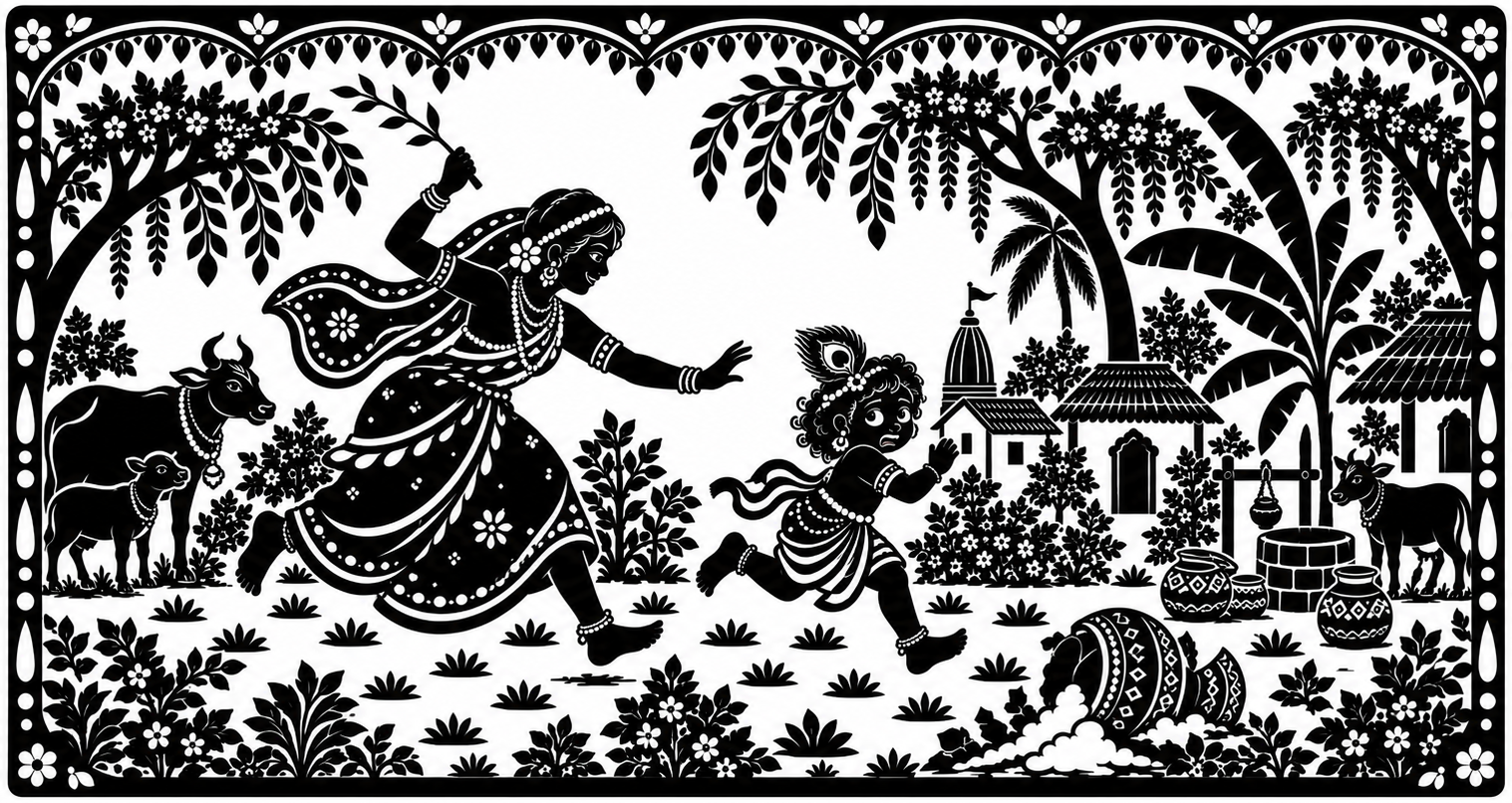
As happy as I am with this daily meditation every Kārtika, I have always found the translation awkward and clunky. The number of English words that are meant to represent each verse seemed out of proportion to the Sanskrit.
So I did some digging and I think, with much help from several large language models with word-for-word meanings of the Sanskrit, I’ve come up with a presentation that is much closer to the original text. I drew only upon Śrī Sanātana Gosvāmī’s Dig-darśinī-ṭīkā for detail and to clarify nuances of meaning. I also wanted the sentence structure to flow more naturally from the tongue, but not at the expense of sacrificing the fidelity and devotional specificity of the original verses. It took some work, and I’d be interested to hear your opinion in the comments here.
Compare the translation of the first verse that is used in many temples today ……
(Side quest: Try to recite the entire translation in one breath.)
To the Supreme Lord, whose form is the embodiment of eternal existence, knowledge, and bliss, whose shark-shaped earrings are swinging to and fro, who is beautifully shining in the divine realm of Gokula, who [due to the offense of breaking the pot of yogurt that His mother was churning into butter and then stealing the butter that was kept hanging from a swing] is quickly running from the wooden grinding mortar in fear of Mother Yaśodā, but who has been caught from behind by her who ran after Him with greater speed-to that Supreme Lord, Śrī Dāmodara, I offer my humble obeisances.
…. to ……
I bow down to the Supreme Lord, whose form is eternal existence, consciousness, and bliss. His glistening earrings swing upon His cheeks as He shines resplendently in Gokula. Out of fear of Mother Yaśodā, He runs from the grinding mortar, but she pursues Him with great haste and catches Him from behind.
The first has a lot of beautiful detail but reads clumsily. Somehow, the translator managed to fit a lot of information into a single sentence with a long succession of subordinate clauses before arriving at “I offer my humble obeisances” which is, interestingly, stated as the first word of the prayer, e.g. “namāmi”. There’s a lot of information here.
Don’t get me wrong, it’s wonderful detail but, for something that is recited daily, it reads more like an introduction to this pastime from the tenth canto of Śrīmad-Bhāgavatam than an invocation verse. Again, I don’t see anything offensive about offering such nectar, but I prefer a translation that follows the text more closely.
Consider the word-for-word deconstruction:
namāmi — I offer my obeisances; īśvaram — to the Supreme Lord; sat — eternal existence; cit — consciousness; ānanda — bliss; rūpam — whose form; lasat — swinging, shining; kuṇḍalam — whose earrings; gokule — in Gokula; bhrājamānam — shining beautifully; yaśodā — of Mother Yaśodā; bhiyā — out of fear; ulūkhalāt — from the grinding mortar; dhāvamānam — running; parāmṛṣṭam — caught, seized; atyantataḥ — exceedingly, very greatly; drutya — having run swiftly; gopyā — by the cowherd woman (Mother Yaśodā).
My translation only offers one extra detail, pulled directly from Sanātana Gosvāmī’s ṭīkā, about Kṛṣṇa’s earrings touching His cheeks when they swing. The idea of the earrings being “shark-shaped” is debatable although the ṭīkā does describe them as “makara-shaped”. I struggled to find anything but traditional artistic depictions of the makara and those renderings had much variance. Sometimes the creature is shown as a composite having the jaws of a crocodile, the trunk of an elephant with a scaly fish body. So to simplify this to just “shark” seems as if we’re perhaps glossing over something?
In any case, here’s a printable PDF file of the Sanskrit and English translation. If anyone can suggest improvements, I’m open to revision.
Śrī Dāmodarāṣṭakam of Satyavrata Muni
Dāso ’smi,
Ekendra Dāsa

Suburban Mysticism is free, but if you feel inspired and want to return some love, consider helping Ekendra to care for cows, or share the article with others.